Sam Altman has a betting pool with his tech CEO friends for the first year a single person builds a billion-dollar company. Dario Amodei, asked the same question at Anthropic's Code with Claude event, said "2026" with 70 to 80 percent confidence. One person, directing AI agents that handle engineering, design, legal, finance, marketing, and operations. The only irreducible human contribution: judgment. Knowing what to build, for whom, and why.
I work with these systems every day. I have watched a single AI agent do in forty minutes what took a junior analyst a week. The capability jumps are not incremental. They are discontinuous, and each one redraws the line between what requires a human and what does not.
AI systems today can write production code, generate legal contracts, design interfaces, run financial models, manage customer interactions, and coordinate complex workflows. Not perfectly. But well enough, and improving on a curve that doubles capability in months, not decades.
If you work in AI, you already know this. You have watched the capability jumps. You have felt the acceleration. You have started asking yourself which of your own skills will be the last to be replicated.
If you do not work in AI, you probably think of it as a better search engine. A chatbot that writes mediocre emails. Something your company's innovation department is piloting. You are not wrong about what it was eighteen months ago. You are dangerously wrong about what it is now.
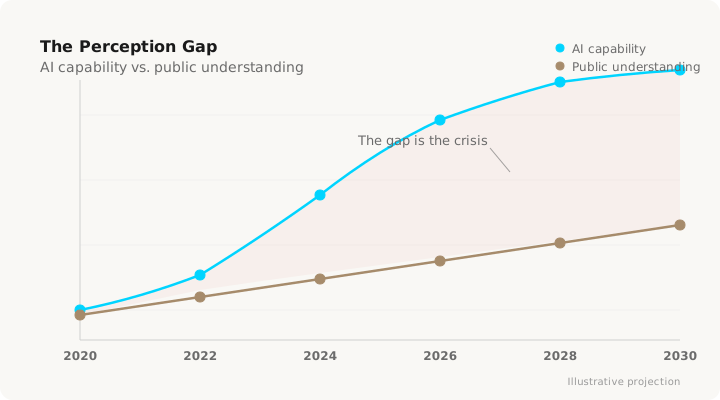
This gap between reality and perception is the most important fact in the European economy today. The technology is moving on an exponential curve, and public understanding is moving in a straight line, and the distance between those two lines is where the crisis lives.
Germany's unemployment rate is 6.3 percent. The social state hums along. Bürgergeld gets paid to 5.5 million recipients. Rentenversicherung collects contributions. The total social budget runs to 1.34 trillion euros a year, about a third of GDP. The system works because it was designed for a world where most adults are employed, contributing taxes, and the small percentage who aren't can be supported by the large percentage who are.
Now run the math forward. Not to 2040, the way consultants like to project, safely distant enough that no one is accountable. Run it to 2027. To 2028. What happens when AI agents can perform the cognitive work of a legal clerk, a financial analyst, a marketing coordinator, a junior developer, a logistics planner, a customer service representative, and a dozen other roles that currently employ millions of Europeans?
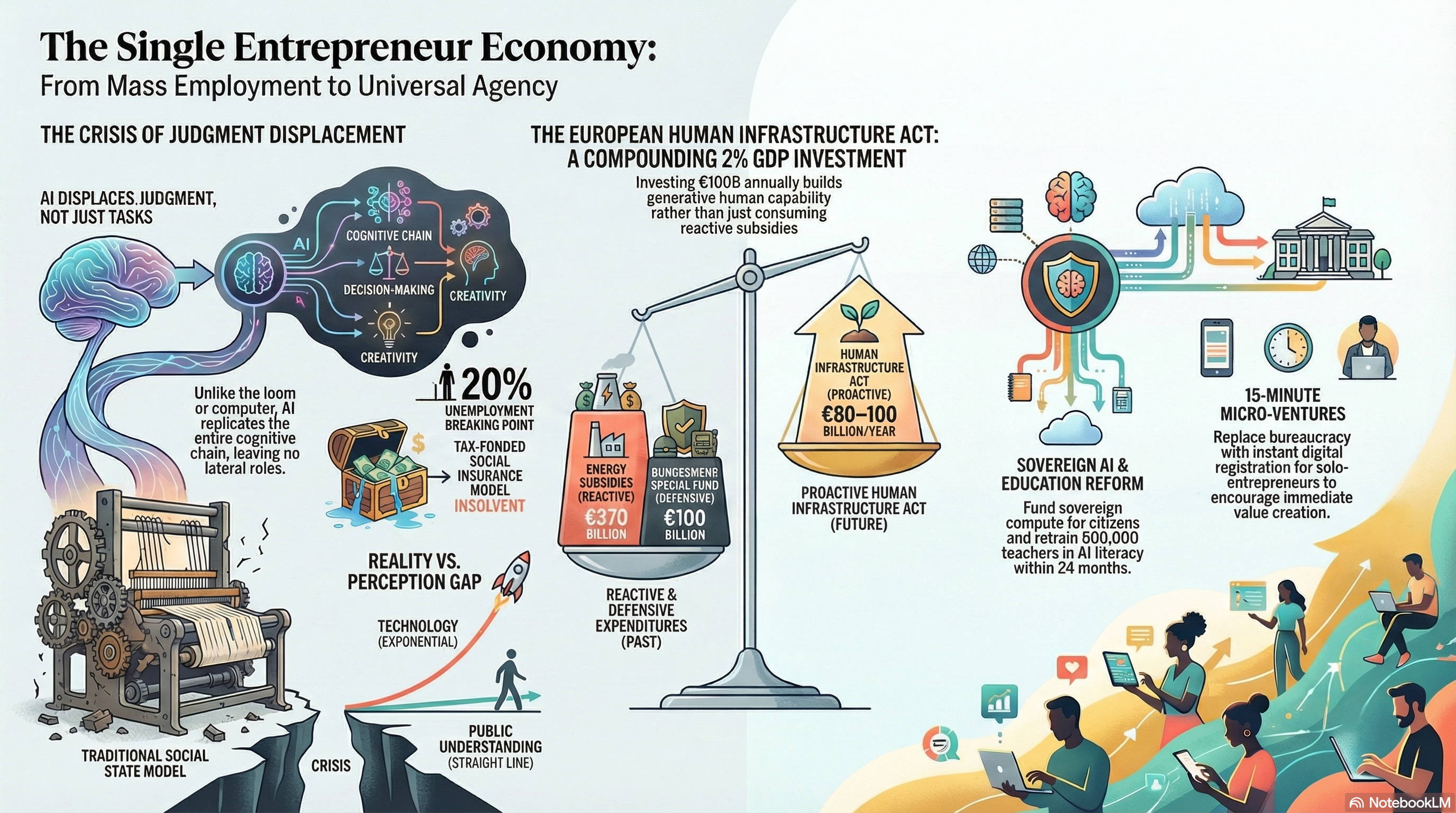
Not all of them at once. Not overnight. But enough of them, fast enough, that the unemployment rate does not drift upward gradually. It steps. If AI agents can perform the work of even 20 percent of the cognitive roles in the German economy within three years, and those roles account for roughly 8 million jobs, the unemployment rate moves from 6 to 14 percent before retraining programs have finished their first intake cycle. The math is not speculative. It is a capacity estimate applied to a timeline that AI labs themselves are projecting.
At twenty percent unemployment, the German social state does not bend. It breaks. The insurance model that underpins it, the assumption that a large employed majority funds support for a small unemployed minority, inverts. And an inverted insurance model is not strained. It is insolvent.
Call it arithmetic applied to trends that are already moving. Nearly no one outside the AI industry is doing the math.
The Fracture
Every previous technological revolution displaced tasks. The loom displaced hand-weaving. The tractor displaced manual plowing. The computer displaced filing clerks. In each case, the technology replaced what human hands or simple calculation did, but left the human mind its role. The weaver became a machine operator. The farmer became an equipment manager. The clerk became a data analyst. The displacement was lateral. The human moved to the adjacent task that still required judgment, creativity, or social intelligence.
AI does not displace tasks. It displaces judgment.
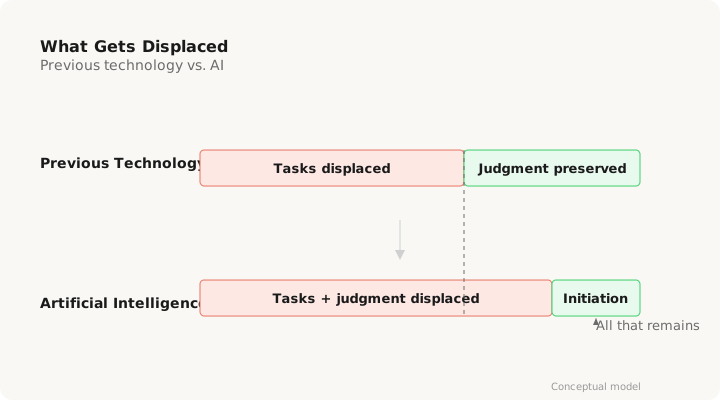
This is the categorical difference that most public conversation about AI still fails to grasp. When an AI system can not only process a legal document but evaluate its risks, not only compile financial data but recommend strategy, not only answer customer questions but anticipate customer needs, the lateral move disappears. There is no adjacent role waiting. The entire cognitive chain that previously required a human has been replicated.
The travel agent is the instructive example. When the internet arrived, the travel agent lost their desk but kept their expertise. They could work for Booking.com, become a specialized luxury travel consultant, or pivot to corporate travel management. The technology displaced the transaction but preserved the judgment.
Now imagine an AI agent that knows every destination, every airline's pricing patterns, every hotel's actual quality from aggregated reviews, and can combine all of this with a specific understanding of what a specific customer actually wants. It doesn't just book the trip. It plans it better than any human could, because it processes more information, faster, without fatigue or bias.
Where does the travel agent go? Not laterally. The judgment itself has been automated. What remains is the capacity to decide that travel planning matters, to identify an unmet need, to initiate something new. But that is not a job skill. That is something different entirely.
There is a counterargument, and it deserves the strongest version of itself.
The World Economic Forum's 2025 Future of Jobs Report projects 170 million new roles created and 92 million displaced globally by 2030. A net positive of 78 million jobs. The argument runs deeper than numbers: technology always creates more jobs than it destroys because it creates entirely new categories of economic activity that were previously inconceivable. The internet did not just automate the travel agent. It conjured into existence the UX designer, the social media manager, the data scientist, the cloud architect, the content creator economy, and entire industries that no one in 1995 could have predicted. Every major technology wave has done the same. The loom destroyed cottage weaving and created the garment industry. The automobile destroyed the horse economy and created suburbs, highways, motels, fast food, and the logistics backbone of modern commerce. The pattern is not just historical. It is structural: when you lower the cost of something dramatically, you expand the total market for everything adjacent to it, and those expanded markets need people.
The strongest form of this argument applied to AI goes further still. If AI makes cognitive work radically cheaper, it does not merely automate existing work. It makes entirely new kinds of work economically viable for the first time. Personalized education for every child. Precision healthcare for every patient. Custom legal counsel for every small business. Environmental monitoring at a resolution that was previously impossible. The optimist case says these new domains will absorb far more labor than AI displaces, just as the internet created far more jobs than it eliminated, in roles that would have sounded like science fiction to a 1990s workforce.
I take this argument seriously. And if AI follows the pattern of previous technologies, the optimists are right and the displacement I am describing does not happen.
But I think the pattern breaks here, for two reasons.
First, the WEF report's own projections depend on companies investing deliberately in people and redesigning work around human-AI collaboration, at a speed and scale that has no historical precedent. The report's timeline is five years. In AI development terms, five years is a geological age. The capabilities that exist at the end of that window will bear little resemblance to the capabilities that exist at the beginning. Projecting job creation based on today's AI is like projecting internet job creation based on dial-up modems.
Second, and more fundamentally: previous technologies created new jobs by opening new domains of human activity. The internet created digital space. That space needed humans to build in it, manage it, populate it. AI does not open a new domain. It enters all existing ones. The new domains the optimists point to, personalized education, precision healthcare, environmental monitoring, are real. But AI does not just make them possible. AI performs the cognitive work those domains require. The jobs created are predominantly for people who can direct and manage AI, and those roles cannot absorb the millions displaced from roles that AI performs autonomously. The net job creation the optimists predict may be real in aggregate and still catastrophic in distribution.
That structural difference is why the institutional responses designed for previous disruptions, retraining programs, Kurzarbeit, job placement services, will not work this time. They assume there is a destination for the retrained worker. An existing role, somewhere, that still needs a human. That assumption is becoming false faster than the institutions can adapt.
The Illusion
Most people never had real agency. They had employment. And for many, that employment was meaningful. The engineer who solved real problems. The teacher who changed lives in their classroom. The meaning was real. None of that was illusory.
But meaning and agency are not the same thing. A person can find deep satisfaction in work that someone else defined, within a system someone else built, serving priorities someone else set. Employment gave people income, structure, social identity, and purpose. These matter enormously. But they are not the same as the capacity to initiate, to decide what should exist and then build it.
That capacity has always been rare. Not because most people lack the ability. Because the economic structure never required it, never cultivated it, and in many ways actively discouraged it. The system trained people to expect participation in someone else's structure. Security in exchange for compliance. A good life, often a very good life, but one that did not develop the muscle of initiation. Why take the risk of starting something when a steady job at Siemens provides everything you need?
The system worked. For decades, it worked well. But it worked by trading agency for stability. And now the stability is dissolving, and the agency was never developed.
This is the real crisis. Not just that jobs are disappearing, but that the disappearing jobs were the only framework most people had for economic participation. Remove the job and the person is stranded, because the capacity to initiate was never cultivated, never rewarded, never even framed as something ordinary people should expect of themselves.
The Inversion
The same technology that destroys employment creates the conditions for genuine agency at a scale that has never existed.
I know this because I live it. I direct AI agents that handle research, drafting, analysis, design, and coordination. The work that used to require a team of five now requires one person with domain expertise and the right tools. Consider what it means that a single person can now direct AI agents to handle engineering, design, legal compliance, financial modeling, marketing, and customer service. It means the minimum viable team for creating economic value has collapsed toward one. Not because the work got simpler. Because the tools got powerful enough to handle the complexity that previously required organizations.
A nurse who spent twenty years in elderly care does not need to find a new job in the care industry. She can build the care solution she always wished existed. The monitoring system that actually works. The coordination tool that prevents the communication failures she watched kill patients. She has the domain expertise. She understands the problem in her body, not just her mind. What she never had was the ability to hire engineers, designers, and business developers to turn that understanding into a product. Now she does not need to hire them. She needs to direct agents that do what they did.
It is ordinary competence amplified by extraordinary tools. The mechanic who knows exactly which diagnostic step every shop skips, building an AI-augmented service that catches what others miss. The teacher who understands why certain students fall through the cracks, creating personalized tools that the education system never could. The logistics worker who sees the inefficiency in the supply chain every day, building an optimization service for the small operators who can't afford enterprise solutions.
None of these require venture capital. None require technical genius. All require something that already exists in the workforce: deep knowledge of real problems, earned through years of direct experience.
But agency does not only mean starting a solo business. That framing is too narrow and it misses the more interesting possibilities. Five climate activists who have spent years marching and petitioning can now build the monitoring tools, the carbon tracking systems, the community energy platforms they have been demanding someone else build. Their activism becomes productive in the economic sense. They are not abandoning their cause. They are finally equipped to execute on it. A group of retired teachers can create the educational resources their school system refused to fund. A neighborhood can build its own local services platform, run by residents, serving residents, using AI to handle the operational complexity that previously required a municipal department.
The common thread is initiation. Not filling a role someone else designed, but deciding what needs to exist and building it. Solo or in small groups. Revenue-generating or community-serving or both. The forms will be as varied as the people who create them.
Not everyone will make this transition. Not because they are incapable, but because it asks something difficult, and not everyone will manage it on the same timeline, and some may not manage it at all. A person who spent thirty years in a structured role cannot be expected to become a self-directed initiator in six months, no matter how good the training. The psychological shift alone takes time. For some, it may take more time than the economy allows.
That is a feature of the design. Because the system does not require everyone to become an entrepreneur. It requires a floor that catches everyone, and a ceiling that constrains no one.
The European Human Infrastructure Act
"How do we pay people who lose their jobs?" is the wrong question. It leads to welfare. The right question, "How do we equip people to create value in an economy that no longer needs them as employees?", leads to infrastructure. The difference between those two questions is the difference between managed decline and genuine transformation.
Cash transfers keep people alive. Tools let them build. And tools are radically cheaper. Giving every German adult an extra 200 euros per month in cash costs 168 billion euros per year. Giving every German adult access to AI tools, literacy training, and business support infrastructure costs a fraction of that. A government choosing between the two should choose the tools.
This is the case for what should be called the European Human Infrastructure Act: an infrastructure investment in human capability, treated with the same urgency and scale as the postwar reconstruction. Bigger than the Energiewende. Bigger than the Bundeswehr Sondervermögen. Proportional to the actual size of what is coming.
Germany allocated 100 billion euros for the Bundeswehr overnight when Russia crossed a border. It committed 270 billion in energy subsidies when gas prices spiked. These were reactive, defensive, and in the case of the energy subsidies, largely consumed without compounding return. What is proposed here is proactive, generative, and builds something that gets more valuable every year it runs. And it addresses a disruption that will dwarf both of those crises in its economic impact.
The Act costs 80 to 100 billion euros per year. Roughly 2 percent of GDP. That is a large number. It is also a number that reflects the actual scale of the transformation. Half-measures are more expensive than bold ones when the alternative is a broken social contract and a population that cannot participate in the economy that replaced the one they trained for. Europe is still among the wealthiest societies in human history. The question is not whether it can afford this. The question is whether it can afford not to, and how much longer the window stays open.
The Act has four pillars.
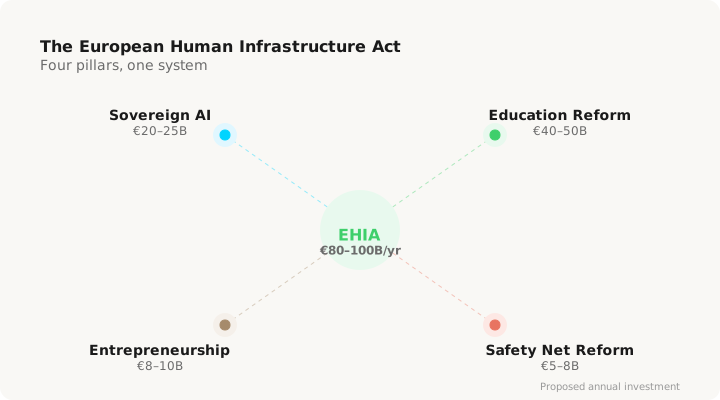
The first pillar is sovereign AI infrastructure. European sovereign compute, European foundation models, European AI infrastructure that serves European citizens and cannot be switched off by a foreign boardroom decision.
Germany has committed 5 billion euros to AI development. Google is investing 5.5 billion in German AI infrastructure through 2029. Deutsche Telekom is building one of Europe's largest AI clouds in Munich. The United States has committed 280 billion dollars through the CHIPS and Science Act, with 200 billion directed at AI and advanced computing research. China is spending at comparable scale. Europe is not in this race. It is watching this race.
The Act changes that. Twenty to twenty-five billion euros per year builds sovereign compute capacity, funds European AI research at globally competitive scale, and provides every citizen free access to AI tools. Not a discount. Not a voucher. Free, the way roads and public libraries are free. Every citizen gets an AI account. Every citizen gets compute. The means of production, for the first time in history, become universally accessible. And they remain under European democratic control, not subject to the terms of service of a Silicon Valley corporation.
The second pillar is emergency education reform. This is where the largest investment goes, because it is the investment with the highest compounding return. The current education system produces graduates for an economy that will not exist by the time they enter it. Fixing this is not a ten-year curriculum review. It is an emergency deployment, and it must be funded like one.
Germany's total public education spending is 191 billion euros across all levels of government. The federal share is 22 billion. The Act adds 40 to 50 billion per year in federal education spending. That is more than doubling the federal education budget. It is the single largest peacetime investment in human capability any European nation has made. And it is what the moment demands.
Start with the teachers. You cannot transform education without transforming the people who deliver it. Every teacher in Germany, all 800,000 of them, must complete AI literacy certification within two years. Not optional continuing education. Mandatory competency, funded and supported by the state. Create a new role: AI Integration Specialists, ten thousand of them, deployed to every school district, working alongside teachers to redesign how subjects are taught when AI can answer any factual question instantly. The point of education is no longer transferring knowledge. It is developing judgment, initiative, and the ability to direct powerful tools toward real problems. Teacher training and the new specialist corps: 8 to 10 billion euros per year.
Redesign the curriculum from age ten onward. AI literacy becomes a core subject, alongside mathematics and language. Not "learn to code." That is already becoming obsolete as AI writes code. What students need is the ability to understand what AI can do, evaluate its output, identify where it fails, and combine it with their own thinking. By secondary school, every student should be directing AI agents toward real problems as part of standard coursework. Build something that addresses a need in your community this semester. Fail. Learn why. Try again. This is not a pedagogical theory. It is how the new economy actually works, and students should practice it before they enter it. Equipment, platform licenses, curriculum development, and new educational materials for every school in the country: 10 to 12 billion per year.
Germany's dual education system, the Ausbildung, is a genuine advantage here. It already values learning through practice. The apprenticeship model, redesigned around AI-augmented work rather than traditional trades, could become the global template for how a developed nation retrains its workforce. But it needs to move faster than institutional culture wants to allow. The Ausbildung system should offer AI-augmented tracks in every existing trade within 18 months. A plumber who can direct AI agents to optimize building energy systems is not a plumber who lost their job. They are a climate solutions provider who happens to understand pipes. Redesigning and scaling the Ausbildung: 5 to 7 billion per year.
For adults already in the workforce or already displaced, the investment is equally urgent. Every Volkshochschule in Germany becomes an AI literacy center. But not only the Volkshochschulen. The Act funds a new national network of AI Werkstätten, hands-on workshops in every city and large town, staffed by practitioners, open to anyone. Not lectures about AI theory. Working sessions where a former logistics worker builds a route optimization tool in three evenings. Where a retired nurse prototypes a patient monitoring system. Where a young person who never finished school discovers they can build something that works. Adult retraining, Volkshochschule conversion, and the AI Werkstatt network: 15 to 18 billion per year.
Total education investment: 40 to 50 billion euros per year. South Korea spends 5.8 percent of GDP on education and has built one of the most technologically literate populations on earth. Germany spends 4.5 percent. The Act closes that gap and redirects the increase toward the specific capabilities the AI economy demands. The alternative is a population that watches the economy transform around them without the ability to participate.
The third pillar is entrepreneurship infrastructure. Starting a full GmbH in Germany requires a notary, weeks of paperwork, and twenty-five thousand euros in share capital. The lighter alternative, the UG, starts at one euro but still demands the notary, the Handelsregister, and a bureaucratic process designed for a different era. Compare this to Estonia, where over 126,000 e-Residents have founded more than 36,000 companies, entirely online, in hours.
The Act creates a new legal form: the Digitale Einzelunternehmung, or whatever the lawyers decide to call it. Registration takes fifteen minutes online. No notary. No minimum capital. Tax filing is automated through AI-assisted tools the government provides. Compliance is handled by the same platform. The goal is to make starting a micro-venture as easy as opening a bank account.
But regulatory reform alone is not enough. The Act funds a national entrepreneurship support infrastructure: mentor networks connecting experienced operators with new founders, seed grants for AI-augmented ventures, shared workspaces in every major city, and a digital platform that matches domain expertise with market opportunity. Total cost for the entrepreneurship pillar: 8 to 10 billion per year. Millions of people creating value instead of consuming benefits. This is the pillar with the fastest direct return.
The fourth pillar is safety net reform. The existing social safety systems stay. Bürgergeld stays. Arbeitslosengeld stays. Healthcare stays. Pensions stay. But the rules change to stop punishing initiative. A person on Bürgergeld who starts building an AI-augmented service and earns their first 1,000 euros keeps every cent of it alongside their benefits. The taper rate starts slowly, not at the first euro. Transition grants of 5,000 euros are available for anyone moving from employment or benefits into a new venture, to cover the gap between starting and earning. The system stops punishing initiative and starts funding it. Cost: 5 to 8 billion per year, declining as people transition to self-generated income.
The math of the full Act:
Sovereign AI infrastructure: 20 to 25 billion per year. Education reform (teachers, curriculum, Ausbildung, adult retraining): 40 to 50 billion. Entrepreneurship infrastructure: 8 to 10 billion. Safety net reform and transition grants: 5 to 8 billion.
Total: approximately 80 to 100 billion euros per year. Two percent of GDP. For context, the Marshall Plan cost recipient nations 2 to 3 percent of GDP annually and rebuilt a continent. The Energiewende costs 30 to 60 billion per year and is transforming the energy system. The European Union has committed 207 billion euros to its Digital Decade targets through 2027. The Act proposed here is larger than any of these individually. It is also addressing a disruption that is larger than any of them individually.
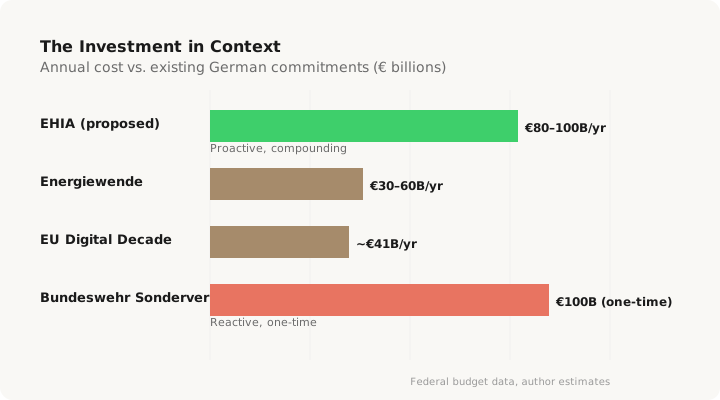
And unlike cash transfers, every euro compounds. The 80 billion spent in year one produces a more capable economy in year two, which makes the 80 billion in year two more productive than the first. AI infrastructure gets cheaper per unit of compute every year. A trained population gets more capable. New ventures generate tax revenue. Treat it as what it is: the highest-return investment a wealthy nation can make right now.
The question of universal basic income remains open and may become necessary as displacement accelerates. But it is not the first move. The first move is to give people the tools, the knowledge, and the regulatory freedom to build their own economic futures. Cash is the fallback for when that fails. Infrastructure is the investment in making sure it does not have to.
The Imperative
Governments must lead. Not because they are good at innovation. Because they are the only institutions with the authority and scale to prepare a population for what is coming. And right now, from where I sit, they are not preparing anyone.
European governments are still treating AI as an innovation topic. Something for the economics ministry. A subject for conferences and white papers and five-year strategies. Meanwhile, the technology is rewriting the economic foundations these governments stand on, and the population they serve has almost no understanding of what is happening.
The first obligation is honesty. Tell people what is coming. Not filtered through corporate optimism about "AI creating new opportunities" or media sensationalism about robot overlords. Clear, factual, public communication about what AI can do now, what it will likely do soon, and what that means for employment across every sector. The information asymmetry between people working in AI and everyone else is staggering. Closing that gap is not optional. It is the precondition for everything the European Human Infrastructure Act proposes. You cannot equip a population that does not understand why it needs equipping.
The Challenge
The transition from an employment-based economy to an agency-based one is the most significant structural change since industrialization, and no single document can map every detail of it.
But we know enough to act. AI displacement is real and accelerating. The social state in its current form cannot absorb it. Agency, not employment, is the future of economic participation. Tools and training matter more than cash transfers. And governments must lead, because no one else has the scale or authority.
What we do not know is exactly how every person finds their path. That is not a weakness in the argument. That is the nature of agency itself. You cannot plan it from above. You can only create the conditions in which it emerges: knowledge of what is possible, tools to act on it, and safety to try and fail.
The question is not whether this change is coming. It is. The question is whether we meet it with preparation or with panic. Whether the Bundestag debates AI literacy mandates in 2026 or unemployment emergency measures in 2028. Whether Brussels launches the European Human Infrastructure initiative this year or scrambles to contain social unrest in three.
History does not generalize well, but it is specific about one thing: large populations that lose economic purpose without a replacement narrative do not wait patiently. The Weimar Republic is the reference no German politician wants to invoke, but the structural parallels are worth examining honestly. Mass economic displacement. Institutions that failed to adapt in time. A population that felt betrayed by the system that was supposed to protect them. The specifics differed from what is coming. The dynamics, the speed at which stability erodes when people lose their stake in the economy, do not.
A population with agency does not radicalize. A population that feels purposeless, dependent, and lied to does. Centuries of evidence confirm this.
The social state promised to look after its people. That promise is worth keeping. But keeping it now requires something it has never required before: not just protecting people from hardship, but equipping them to create their own futures. Sovereign AI infrastructure under democratic control. Every teacher trained in 24 months. AI literacy in every school from age ten. Ten thousand AI Integration Specialists in classrooms across the country. Every Volkshochschule converted to an AI Werkstatt. A micro-venture registrable in fifteen minutes. A safety net that funds initiative instead of punishing it. The European Human Infrastructure Act, at 2 percent of GDP, builds all of it. And unlike the reactive expenditures Germany has already proven willing to make, every euro compounds.
I think about the nurse. Twenty years of watching systems fail the people she cared for. She knows exactly what needs to exist. For the first time in history, she can build it. That possibility is real, and it is fragile, and it will not wait for the next legislative cycle. Eighty billion euros a year buys her the tools, the training, and the safety to try. It buys it for millions like her. Two percent of GDP to keep a promise that the social state has always made but never had to keep like this: that its people will not be left behind.